

Space Enterprises India is an ISO 9001:2015 certified tubular heater manufacturer and supplier based in Amritsar, Punjab, building tube heaters for air heating, oil heating and process-heating applications since 1982 under the supervision of proprietor Mr. Darshan Singh. Whether you need a manufacturer to bend and finish a tubular heater to your exact shape and wattage, or a supplier who can keep standard profiles in stock, this guide covers how tubular heaters work, how to choose the right finish and sheath, and what to check before you order.
ISO 9001:2015 Certified
Based in Amritsar, Punjab
Custom bends & wattage
Pan-India shipping
What Is a Tubular Heater?
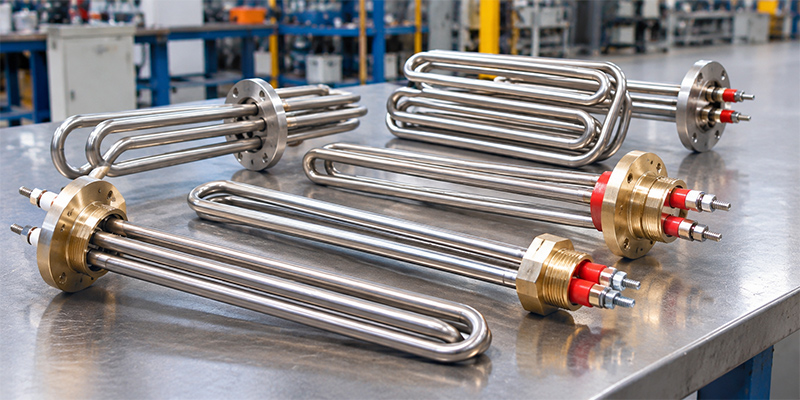
A tubular heater, also called a tube heater, is a resistance heating element sealed inside a metal tube that can be bent, formed, and finished into almost any shape, straight, U-shaped, coiled, or custom-bent, to fit a specific heating application. Unlike a fixed-shape cartridge or band heater, a tubular heater’s sheath can be shaped around the surface or space it needs to heat, which makes it one of the most flexible heating elements used in industrial equipment. As a tubular heater manufacturer, we bend and finish each unit to the exact profile and length your application calls for.
As a tubular heater supplier, we also keep commonly used straight and finned tubular profiles ready so customers needing a quick replacement are not left waiting on a full custom bending job.
How a Tubular Heater Works
Inside a tubular heater, a coiled resistance wire, usually nickel-chromium (nichrome), runs through the centre of a metal tube and is packed tightly in compressed magnesium oxide (MgO) insulation, which conducts heat while blocking electrical current. The entire assembly is then drawn down and bent to the required shape without breaking the internal insulation or wire.
As current passes through the resistance wire, heat is generated and conducts outward through the MgO insulation and the metal sheath to the surface, air, or liquid the tube is heating. Because the tube itself can be formed into almost any shape, tubular heaters are used both as standalone heating elements and as the heating core inside finned air heaters, immersion heaters, and band heater assemblies.
Types of Tubular Heaters We Manufacture
Straight Tubular Heaters
Simple straight-tube elements for ducts, tanks, and general-purpose heating.
U-Shaped Tubular Heaters
Bent into a U profile for compact mounting in tanks and small enclosures.
Finned Tubular Heaters
Fitted with fins to increase surface area for efficient air and gas heating.
Coiled Tubular Heaters
Wound into a coil for compact installations with a longer heated length.
Flanged Tubular Heater Bundles
Multiple tubular elements mounted on a single flange for tank and vessel heating.
Custom-Bent Tubular Heaters
Bent to a drawing or sample to match an existing part or unusual mounting space.
Tubular Heaters vs Band Heaters vs Cartridge Heaters
| Heater Type | Shape Flexibility | Best For |
|---|---|---|
| Tubular heater | High, can be bent into almost any shape | Air heating, finned assemblies, tank bundles, custom shapes |
| Band heater | Fixed, clamps around a cylindrical surface | Barrels, nozzles, pipes |
| Cartridge heater | Fixed, inserted into a drilled hole | Dies, molds, platens |
Sheath Material: Choosing the Right One
| Sheath Material | Best Suited Application | Notes |
|---|---|---|
| Stainless steel (SS304/SS316) | Air heating, general-purpose, mild chemical exposure | Good balance of cost and corrosion resistance |
| Incoloy | High-temperature air and oil heating | Withstands higher sheath temperatures than stainless steel |
| Copper | Clean water heating | Good heat transfer, not suited to corrosive or oil applications |
| Titanium | Highly corrosive liquids, salt water | Specialist applications where other metals corrode quickly |
Matching sheath material to the application is one of the biggest factors in tubular heater life, so it is worth confirming the operating environment, air, oil, or liquid, and its temperature before finalising a specification.
Standard Features
Custom Bending
Bent to your drawing or sample, including multi-bend and coiled profiles.
Watt Density Control
Wattage distributed evenly or concentrated where extra heat is needed.
Flexible Termination
Terminal box, flying leads, or screw terminals to match your wiring setup.
Finning Options
Fins added for higher-efficiency air and gas heating applications.
Typical Specifications
| Parameter | Typical Range |
|---|---|
| Voltage | 110V to 440V, single or three phase |
| Wattage | Low to high watt density, built to application |
| Sheath material | Stainless steel, Incoloy, copper, or titanium |
| Shape | Straight, U-shaped, coiled, finned, or custom-bent |
| Termination | Terminal box, flying leads, or screw terminals |
Materials Used
Resistance Wire
Nickel-chromium (nichrome) wire for stable resistance and long life at high temperature.
Insulation
Compressed magnesium oxide (MgO) packed tightly around the resistance wire for heat transfer and electrical insulation.
Sheath
Stainless steel, Incoloy, copper, or titanium, selected to match the application.
Fins
Metal fins added where required to increase surface area for air heating.
Tubular Heater Manufacturer vs Supplier: What’s the Difference?
A manufacturer winds the element, packs the insulation, and bends the tube to your exact shape and length. A supplier sources or stocks tubular heaters, sometimes manufactured elsewhere, and sells them on. Space Enterprises India does both: we manufacture every tubular heater in-house at our Amritsar facility, with full bending and finishing capability, and we act as a supplier by keeping standard straight and finned profiles ready to ship, so customers get manufacturer-level accuracy with supplier-level turnaround on repeat orders.
Signs You Need a Replacement Tubular Heater
Uneven Heating
Hot and cold spots along the tube usually point to internal insulation breakdown.
Tripping Breakers or ELCBs
Often a sign of moisture ingress into the MgO insulation, lowering insulation resistance.
Visible Cracks or Discolouration
Cracked or heavily discoloured sheath metal signals the element is nearing end of life.
Slow Heat-Up
A system taking noticeably longer to reach temperature usually means reduced element output.
How to Choose the Right Tubular Heater Manufacturer
Share your required shape, length, wattage, voltage, and the medium being heated (air, oil, or liquid). A reliable manufacturer should recommend sheath material and watt density based on your application rather than selling one standard tube regardless of fit.
Also check whether the manufacturer can bend to a sample or technical drawing, and whether they test insulation resistance on each unit before dispatch.
For background on how resistance heating elements work in general, the Wikipedia overview of heating elements is a useful reference.
What Affects Tubular Heater Price
- Sheath material: Incoloy and titanium cost more than stainless steel or copper.
- Bending complexity: multi-bend or coiled shapes cost more than straight tubes.
- Wattage and length: longer, higher-wattage tubes use more material and resistance wire.
- Finning: finned tubular heaters cost more than plain tubes due to the extra fabrication.
- Order quantity: per-unit cost drops on larger production runs for the same specification.
Safety Tips for Tubular Heater Installation
- Always isolate power before fitting, removing, or servicing any tubular heater.
- Use a properly rated contactor and thermostat, with a high-limit cutout as a backup safety measure.
- Avoid sharp re-bending of an already-formed tube, as this can crack the sheath or damage the internal insulation.
- Check that airflow or liquid flow around the heater is sufficient to prevent local overheating.
- Inspect terminal connections periodically for looseness or corrosion.
Common Applications of Tubular Heaters
Air & Duct Heating
Finned tubular heaters mounted in ducts and air handling units for process air heating.
Oil & Process Fluid Heating
Flanged tubular bundles for heating oil and process fluids in tanks.
Industrial Ovens & Dryers
Straight and U-shaped tubular elements as the heating core inside ovens and dryers.
Water Heating
Copper-sheathed tubular heaters for storage tanks and water heating equipment.
Packaging & Shrink-Wrap Machines
Compact coiled or bent tubular elements for localized heating zones.
Plastics & Extrusion
Custom-bent tubular heaters built into barrel and die heating assemblies.
Bulk and OEM Supply
Beyond one-off replacements, we support machine builders and process equipment manufacturers who need tubular heaters as a component in their own finished product. For OEM buyers, we can hold an agreed bend profile and specification on file, so repeat orders ship quickly without re-confirming the design each time. This has made us a steady tubular heater supplier for customers who build their own ovens, dryers, or air-heating equipment and need a dependable heating element partner rather than a one-time vendor.
If your production volumes are large enough to justify it, we can also discuss pricing tiers based on order quantity, so your per-unit cost reflects the scale of your business rather than a single-unit custom quote every time.
How to Size a Tubular Heater
Heated Area or Volume
The surface area, duct size, or tank volume to be heated determines the base wattage requirement.
Temperature Rise
The difference between starting and target temperature affects how much wattage and watt density you need.
Available Space
The mounting space and clearance available often determine whether a straight, U-shaped, or coiled profile fits best.
Medium Being Heated
Air, oil, or liquid heating each call for a different watt density ceiling to avoid overheating the sheath.
Share your heated area or tank volume, the medium being heated, your target temperature, and the mounting space available, and we can recommend the right shape, wattage, and sheath material rather than guessing from a single dimension.
Tubular Heater Installation Checklist
- Confirm the available mounting space matches the bend profile you are ordering before finalising the shape.
- Verify the sheath material is compatible with the medium (air, oil, or liquid) being heated.
- Install a high-limit thermostat or cutout in addition to the main control thermostat.
- Ensure adequate airflow or liquid flow around the heated section to prevent local hot spots.
- Route electrical connections through a properly rated enclosure, away from heat, moisture, or vibration.
- Test the installation at low power before running at full wattage for the first time.
Maintenance Tips for Tubular Heaters
- Inspect the sheath periodically for discolouration, cracking, or pitting, especially in corrosive or high-temperature environments.
- Check terminal connections for looseness or corrosion, particularly in vibration-heavy equipment like extruders or ovens.
- Test insulation resistance on an annual basis for process-critical installations, to catch MgO insulation degradation before it causes a trip or failure.
- Keep a spare element on hand for process-critical equipment where downtime has a direct production cost.
Why Space Enterprises India
We have manufactured tubular heaters since 1982 from our ISO 9001:2015 certified facility at 77 Focal Point, Amritsar, Punjab, under the supervision of proprietor Mr. Darshan Singh. Over four decades, we have supplied tubular heaters to plastics, chemical, food processing, textile, and process-heating businesses across Punjab and the wider Indian market, building a track record that OEM buyers and facility managers can check against our existing customers before placing a first order. Read our heating elements manufacturer guide for our full heater range, or browse our complete product range.
Related Products
Need a Tubular Heater Built to Your Shape?
Send us your required shape, length, wattage and the medium being heated and we’ll quote a custom tubular heater.
Frequently Asked Questions
What shapes can a tubular heater be bent into?
Tubular heaters can be bent into straight, U-shaped, coiled, finned, or fully custom profiles to match your application or an existing sample.
Are you a tubular heater manufacturer or a supplier?
Both. We manufacture every tubular heater in-house at our Amritsar facility, with full bending and finishing capability, and we also supply standard profiles quickly for repeat orders.
Can you bend a tubular heater to match my existing part?
Yes. Send us a sample or technical drawing of your existing tubular heater and we will match the shape, length, wattage, and termination for a direct replacement.
What is the typical lead time for a custom tubular heater?
Lead time depends on the bend complexity, wattage, sheath material, and quantity ordered. Contact us with your specification and we will confirm a delivery timeline with the quote.
Do you supply tubular heaters outside Punjab?
Yes, we manufacture in Amritsar, Punjab and ship tubular heaters to customers across India.
What voltage and wattage options are available?
We build tubular heaters for 110V to 440V, in single or three phase, with wattage matched to your application.
Is Space Enterprises India an ISO certified manufacturer?
Yes, Space Enterprises India is an ISO 9001:2015 certified manufacturer and supplier of industrial heating equipment, operating since 1982.
What sheath materials do you offer for tubular heaters?
We offer stainless steel, Incoloy, copper, and titanium sheaths, selected based on the application and medium being heated.
What information do you need to quote a tubular heater?
Ideally the required shape, length, wattage, voltage, and the medium being heated. A sample or drawing of your old heater also helps us confirm the match quickly.